



Choosing the right flexible packaging pouch is an important decision for product protection, shelf life, storage, transportation, and customer experience. With different pouch styles, material structures, barrier properties, and customization options available, selecting suitable packaging requires more than comparing prices.
For food brands, food processors, wholesalers, and other B2B buyers, the best packaging solution depends on the product being packed, its storage conditions, distribution requirements, and intended use. A pouch designed for roasted coffee, for example, may require different barrier properties and functional features from one used for frozen seafood or liquid products.
This guide explains how to choose flexible packaging pouches step by step, from identifying product requirements to evaluating suppliers and requesting a quotation.
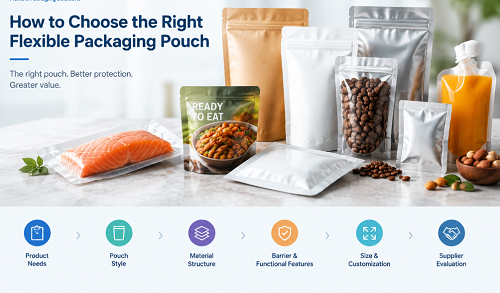
1. Identify Your Product and Packaging Requirements
Before selecting a pouch style or material, define the requirements of the product you intend to package. These requirements determine the level of protection, packaging structure, and functional features you may need.
Consider the Product Type
Different products have different packaging needs. Start by identifying the physical characteristics of your product and any factors that could affect packaging performance.
Dry foods: Snacks, nuts, powders, and dried ingredients may require moisture protection and effective sealing.
Coffee and tea: These products may need protection from oxygen, moisture, and light to help preserve aroma and quality.
Frozen products: Frozen meat, seafood, and other products may require moisture resistance, reliable seals, and resistance to handling damage.
Liquid products: Sauces, beverages, and liquid ingredients require suitable sealing structures and, where applicable, compatible spouts or fitments.
Heat-processed foods: Products subjected to retort processing require packaging materials and seals designed and validated for the relevant processing conditions.
Define Storage and Distribution Conditions
Consider how the packaged product will be stored, transported, displayed, and used. Important factors include ambient or refrigerated storage, freezing, exposure to sunlight, transportation distance, stacking pressure, and the expected shelf life.
You should also clarify whether the pouch will be used for retail display, bulk packaging, food service, industrial distribution, or direct consumer use. These factors influence the choice of pouch style, material structure, dimensions, and opening method.
Establish Your Shelf-Life Requirements
Define the intended shelf life and the product quality attributes that must be maintained. Packaging selection should account for the product's sensitivity to oxygen, moisture, light, and other environmental factors.
Actual shelf life depends on multiple variables, including the product formulation, filling process, storage conditions, seal integrity, and packaging performance. Material selection alone cannot guarantee a specific shelf life.
Need help identifying the right pouch for your product?
Share your product type, storage conditions, and packaging goals to start evaluating suitable flexible packaging options.
Discuss Your Packaging Needs2. Choose the Right Flexible Packaging Pouch Style
Once you understand your product requirements, the next step is to choose a pouch style. Pouch design affects filling efficiency, shelf presentation, storage convenience, and how consumers access the product.
Stand-Up Pouches
Stand-up pouches feature a bottom gusset that allows the package to stand upright when filled. They are commonly considered for snacks, dried foods, coffee, pet food, and various consumer products.
This style can provide a visible front display area and may be combined with features such as resealable zippers, tear notches, and transparent windows when the selected material structure allows.
Flat-Bottom Pouches
Flat-bottom pouches have a structured base that helps the package stand upright and provides multiple display panels. They may be suitable for coffee, premium snacks, powders, and other products where shelf presentation and package stability are important.
Buyers should compare the required capacity, filled-package dimensions, material consumption, and filling compatibility before choosing this style.
Side-Gusset Pouches
Side-gusset pouches expand at the sides to accommodate product volume. They are often considered for coffee, bulk dry goods, and other products that benefit from a relatively compact package shape.
Depending on the design, they can be suitable for different filling and sealing arrangements. Confirm the required filling method and final package configuration with the supplier.
Flat Pouches and Three-Side-Seal Pouches
Flat pouches have a simple, space-efficient structure and are often used for single-serving products, samples, small quantities, and products that do not require a self-standing package.
Three-side-seal pouches are sealed along three edges, with the remaining side typically used for filling before final sealing. They may be considered for food portions, sachets, samples, and other compact packaging applications.
Vacuum Pouches
Vacuum pouches are designed for applications where air is removed from the package before sealing. They may be used for meat, seafood, cheese, and selected industrial products, depending on the material structure and packaging process.
For vacuum applications, evaluate puncture resistance, seal performance, product compatibility, and the intended storage conditions. Not every flexible pouch material is suitable for vacuum packaging.
Retort Pouches
Retort pouches are designed for products processed under specified heat and pressure conditions. They may be used for ready-to-eat meals, sauces, and other suitable food products.
Because retort processing places particular demands on packaging materials and seals, buyers should confirm the processing temperature, duration, product characteristics, and validation requirements before selecting a pouch.
Spouted Pouches
Spouted pouches are used for selected liquid and semi-liquid products, such as sauces, beverages, purees, and liquid concentrates. A suitable spout or fitment can make pouring and dispensing more convenient.
When evaluating this style, check the spout location, opening size, filling equipment compatibility, leakage resistance, and the intended user experience.
| Pouch Style | Common Applications | Key Selection Considerations |
|---|---|---|
| Stand-up pouch | Snacks, dried foods, pet food | Shelf display, capacity, resealability |
| Flat-bottom pouch | Coffee, premium snacks, powders | Package stability, display panels, filling method |
| Side-gusset pouch | Coffee, bulk dry goods | Product volume, storage efficiency, sealing design |
| Flat or three-side-seal pouch | Samples, sachets, single portions | Compact dimensions, portion size, sealing |
| Vacuum pouch | Meat, seafood, selected food products | Puncture resistance, vacuum compatibility, seal integrity |
| Retort pouch | Suitable heat-processed foods | Process conditions, material compatibility, seal validation |
| Spouted pouch | Sauces, purees, liquid products | Fitment compatibility, dispensing, leak resistance |
3. Select the Right Flexible Packaging Material Structure
Flexible packaging pouches may use single-layer materials or multiple layers combined to achieve specific packaging performance. The appropriate structure depends on the product, processing method, barrier requirements, mechanical demands, and intended storage conditions.
Understand Common Packaging Materials
PE (Polyethylene): Commonly used for its flexibility and heat-sealing properties. Its performance depends on the specific PE grade and structure.
PET (Polyethylene Terephthalate): Often used as an outer layer because of its strength, dimensional stability, and suitability for printing in appropriate structures.
PA (Polyamide): Often considered when toughness and puncture resistance are important. Its suitability depends on the application and the complete material structure.
Aluminum foil: Can provide a high barrier against light, oxygen, and moisture when incorporated into a suitable laminate.
Metallized films: May improve barrier performance and provide a metallic appearance. Their barrier properties differ from those of aluminum foil and depend on the film and construction.
These materials are not interchangeable in every application. A supplier should recommend a complete material structure rather than evaluating an individual layer in isolation.
Match the Material Structure to Your Product
The following examples can help guide the initial selection process. They are starting points rather than universal specifications; the final structure should be confirmed through technical evaluation and product testing.
| Product Category | Potential Material Considerations | Important Questions |
|---|---|---|
| Coffee and tea | Suitable aroma, oxygen, moisture, and light barrier structure | Is a degassing valve required? What shelf life is targeted? |
| Snacks and dry foods | Moisture barrier, sealability, and appropriate mechanical strength | Are the contents sensitive to moisture, oxygen, or light? |
| Frozen meat and seafood | Cold-temperature performance, toughness, and puncture resistance | Will the pouch be vacuum sealed or exposed to sharp edges? |
| Liquid products | Compatible sealing structure and suitable fitment integration | What are the filling temperature, viscosity, and storage conditions? |
| Retort foods | Materials and seals validated for the intended retort process | What are the actual processing temperature, pressure, and duration? |
Consider Sustainable Packaging Options
If sustainability is part of your purchasing criteria, discuss material reduction, recyclable structures, and other packaging alternatives with your supplier. The available options depend on the product's barrier requirements, filling process, local recycling infrastructure, and applicable regulations.
Do not assume that a pouch is recyclable or environmentally preferable based only on its appearance or the name of one material. Request supporting technical information and confirm whether the complete structure is compatible with the intended recycling system.
4. Determine the Required Barrier and Functional Properties
After choosing a preliminary pouch style and material structure, identify the performance properties needed to protect the product and support the packaging process.
Oxygen and Moisture Barrier
Oxygen can contribute to oxidation and quality changes in sensitive products, while moisture can affect texture, stability, and product usability. The required barrier level depends on the product formulation, target shelf life, storage conditions, and packaging process.
For products with demanding shelf-life requirements, ask the supplier for relevant oxygen transmission rate (OTR) and water vapor transmission rate (WVTR) data. Compare results under consistent testing conditions and confirm that the proposed structure meets your requirements.
Light Protection
Some products are sensitive to light exposure. Opaque structures, foil laminates, and other suitable barrier materials may help reduce exposure. The best option depends on the product's sensitivity and whether consumers need to see the contents through the package.
Puncture Resistance and Mechanical Strength
Products with sharp edges, heavy contents, or demanding distribution conditions may require additional mechanical protection. Consider the risk of punctures, abrasion, compression, drops, and damage during transportation.
For frozen or vacuum-packed products, evaluate the complete package under realistic handling and storage conditions instead of relying only on nominal film thickness.
Heat-Sealing Performance
Reliable seals are essential for package integrity. The material structure should be compatible with the filling and sealing equipment, including its operating temperature, pressure, and dwell time.
Confirm that the proposed pouch can run on your equipment and that the seal performance is appropriate for the product, filling speed, and distribution environment.
Choose Functional Features Carefully
Additional features can improve convenience, product handling, and shelf presentation. Common options include:
Resealable zipper: Useful when a product is consumed over multiple occasions.
Tear notch: Helps consumers open the package more easily.
Degassing valve: May be appropriate for freshly roasted coffee that releases gas after roasting.
Spout or fitment: Supports pouring or dispensing for suitable liquid products.
Hang hole: Can support retail display for selected pouch formats.
Transparent window: Allows consumers to view the contents where the selected structure and barrier requirements permit.
Include only the features that support your product and customer needs. Each additional component can affect packaging cost, production complexity, and compatibility with filling equipment.
Looking for the right material structure and pouch features?
Discuss your barrier requirements, sealing method, and customization preferences with Meiji Packaging.
Discuss Material Options5. Confirm Pouch Size, Capacity, and Customization Options
The correct pouch dimensions help ensure that the package holds the required quantity, works with the filling process, and presents the product appropriately.
Determine the Required Dimensions
Provide the target fill weight or volume, product density, and preferred finished-package dimensions. For products with irregular shapes or large particles, volume and physical dimensions may be just as important as weight.
If you already use a pouch, provide a sample or its technical drawing. If you are developing a new package, ask the supplier to recommend preliminary dimensions and validate them through sampling.
Confirm Closures and Other Specifications
Before approving the design, clarify all required components and specifications, including:
Finished pouch width, height, and gusset dimensions, where applicable
Target fill weight or volume
Material structure and nominal thickness
Closure type, zipper, spout, valve, or other fitment
Printing method, artwork, colors, and finish
Seal area and compatibility with filling equipment
Packaging quantity, carton configuration, and shipping requirements
Review Printing and Branding Requirements
Custom printing can help communicate your brand, product information, and usage instructions. Prepare artwork, color references, required label information, and any applicable market-specific packaging requirements before production.
Ask for a sample or proof to review the design and dimensions. Where necessary, test the pouch using your actual product and filling equipment before placing a large production order.
6. Evaluate the Supplier and Total Packaging Cost
A suitable packaging supplier should be able to help you assess material selection, pouch design, customization, production requirements, and quality control. For B2B buyers, the lowest unit price does not always represent the lowest overall cost.
Check Relevant Manufacturing Capabilities
Evaluate whether the supplier can meet your required pouch styles, material structures, printing specifications, dimensions, and functional features. Confirm that the supplier has experience with your product category and intended packaging process.
Depending on your requirements, ask about quality-control procedures, material traceability, technical documentation, and applicable food-contact or other compliance documentation. Verify any certification or compliance claims against the actual documents provided.
Compare Minimum Order Quantity and Lead Time
Minimum order quantity (MOQ) and lead time can influence your inventory planning and product launch schedule. Confirm the MOQ for your selected pouch structure, printing method, and customization requirements.
Ask for separate timelines for sampling, artwork approval, production, inspection, and shipping. If you need recurring orders, discuss the supplier's ability to support your forecast and replenishment schedule.
Calculate the Total Cost
When comparing quotations, consider more than the price per pouch. Review the following cost factors:
Unit price at different order quantities
Printing, cylinder, plate, tooling, or setup charges, where applicable
Sampling and design-related costs
Shipping, customs, and delivery-related expenses
Expected product loss or packaging waste
Storage costs and inventory requirements
Potential costs associated with seal failures, damage, or incompatible packaging
A structured comparison helps you evaluate supplier quotations on a consistent basis. Make sure each supplier is quoting the same pouch dimensions, material structure, thickness, printing specifications, features, and order quantity.
7. Flexible Packaging Pouch Selection Checklist
Use this checklist before requesting quotations or approving a production sample. Providing complete information can help suppliers recommend suitable options and prepare more accurate pricing.
| Selection Item | Information to Prepare |
|---|---|
| Product information | Product type, composition where relevant, fill weight or volume |
| Storage and shelf life | Ambient, refrigerated, frozen, or heat-processed conditions; target shelf life |
| Pouch style | Stand-up, flat-bottom, side-gusset, flat, vacuum, retort, spouted, or another design |
| Material structure | Required barrier properties, mechanical performance, and sealing compatibility |
| Functional features | Zipper, tear notch, valve, spout, window, hang hole, or other components |
| Dimensions | Target width, height, gusset, fill capacity, and thickness requirements |
| Printing and artwork | Artwork files, colors, finish, and required product information |
| Order requirements | MOQ, estimated annual demand, initial quantity, and reorder frequency |
| Delivery requirements | Destination country, required delivery date, and shipping preferences |
| Testing and compliance | Required performance tests, food-contact requirements, and supporting documents |
8. Frequently Asked Questions About Flexible Packaging Pouches
What is the best flexible packaging pouch for food products?
There is no single best pouch for every food product. Stand-up pouches may suit snacks and dry foods, vacuum pouches may suit selected meat and seafood applications, and retort pouches may be suitable for foods processed under specific heat and pressure conditions. The right choice depends on product characteristics, shelf-life requirements, processing conditions, and distribution needs.
What is the difference between a stand-up pouch and a flat-bottom pouch?
A stand-up pouch typically uses a bottom gusset to stand upright when filled. A flat-bottom pouch has a structured base and can provide multiple display panels. Both can be used for selected food and consumer products, but their capacity, stability, appearance, and cost may differ.
Which flexible packaging materials provide high barrier protection?
Aluminum foil laminates and certain engineered multilayer structures can provide high barrier performance against oxygen, moisture, and light. The actual performance depends on the complete material structure, thickness, construction, and package integrity. Request technical data relevant to your application before making a final selection.
Can flexible packaging pouches be customized?
Many pouch designs can be customized in dimensions, material structure, printing, closure type, and selected functional features. Available options depend on the supplier's manufacturing capabilities, the chosen pouch style, and the product's technical requirements. Confirm customization options and minimum order quantities before production.
What information is needed to request a flexible packaging pouch quotation?
Prepare your product type, target fill weight or volume, preferred pouch style, dimensions, material requirements, printing artwork, required features, order quantity, and delivery destination. If you have an existing pouch sample or technical drawing, provide it to help the supplier assess your requirements.
Should I test the pouch before mass production?
Yes. When possible, evaluate samples using the actual product, filling equipment, sealing conditions, and expected storage or distribution environment. Testing can help identify issues with dimensions, filling efficiency, seal integrity, leakage, barrier performance, and handling before a larger order is produced.
Conclusion: Choose a Pouch Based on Product Performance and Purchasing Needs
Choosing the right flexible packaging pouch involves a sequence of decisions: identify product requirements, select a pouch style, determine the material structure, evaluate barrier and functional properties, confirm dimensions and customization, and assess the supplier's capabilities and total cost.
A clear specification makes it easier to compare packaging options, reduce unnecessary features, and select a pouch that fits your product and production process. Before finalizing an order, confirm the proposed structure with technical data, samples, and appropriate performance testing.
Meiji Packaging can be contacted to discuss your flexible packaging requirements, subject to the company's available product range and customization capabilities. Prepare your product details, target quantity, preferred pouch style, and destination market to support a more focused inquiry.
Ready to source flexible packaging pouches for your business?
Share your specifications and order requirements to discuss suitable packaging options and request a quotation.
Request a Packaging Quote
